Peer‑Validated Guidance for Banking Security Leaders
From AI governance to deepfake fraud and DORA compliance, IANS helps you focus on what matters now and move forward with confidence.
WHAT SECURITY LEADERS ARE ASKING NOW
Which banking security risks demand action?
Banking CISOs are contending with multiple high-stakes pressures at once—and most teams are already mid-stream, not starting from scratch.
Across banking, security leaders are grappling with AI‑enabled threats and early‑stage AI governance, a surge in deepfake fraud and threat intelligence demands, and enterprise and third‑party risk programs strained by volume, mergers, and regulatory scrutiny—all while headcount and budgets remain tight.
Banking security leaders don’t lack tools; they lack clear signal, peer validation, and defensible paths forward when everything feels urgent.
Your peers have already solved the challenges you're facing. IANS connects you to their experience. Read on for practitioner-validated, vendor-free direction, built for the decisions you face every day.
Proven priorities in banking security
Every week, banking CISOs face the same problem: everything looks urgent, but not everything matters equally.
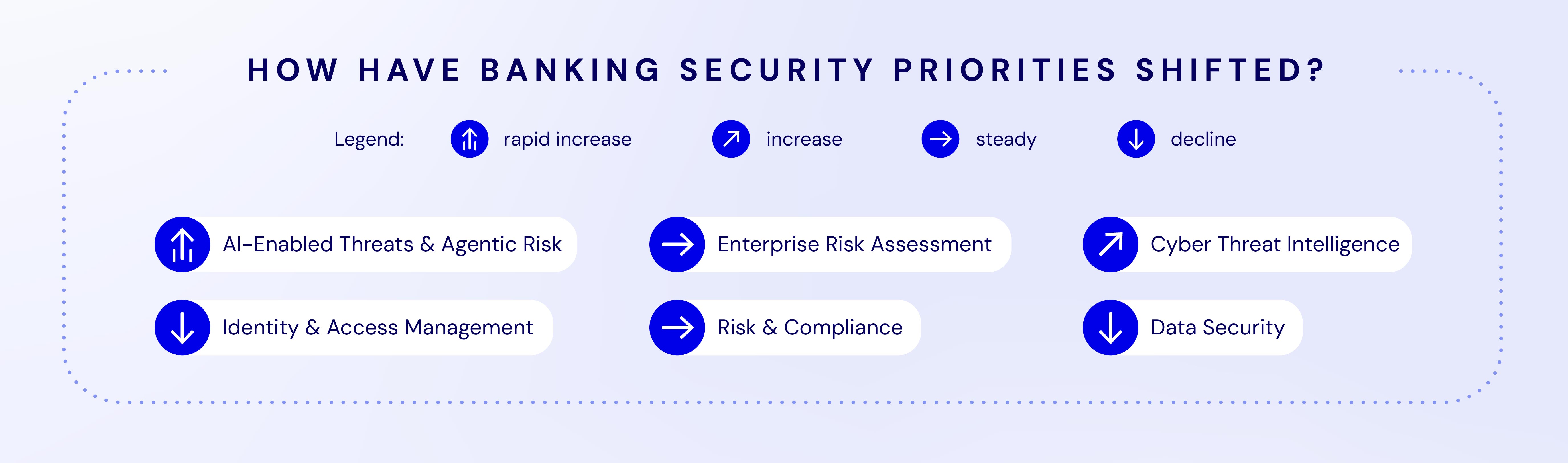
This infographic highlights the proven priorities emerging from nearly 290 banking security leader conversations—what's rising, what's steady, and where teams are taking action now.
Use it to focus your effort, pressure test your roadmap, and align stakeholders.
AI ENABLED RISK & AGENTIC AI
AI risk is accelerating faster than governance
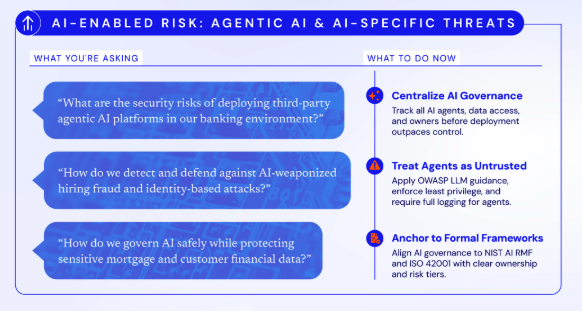
"What are the security risks of deploying third-party agentic AI platforms in our banking environment?"
AI-enabled risk is the fastest‑growing concern among banking security teams, spanning both offensive threats and internal governance challenges.
On the threat side, teams are tracking AI‑weaponized fraud, deepfake impersonation, and identity‑based attacks. Internally, many organizations are still establishing foundational governance as AI adoption moves faster than controls.

Shift your focus to:
- Clear ownership of AI systems and decisions
- Visibility into AI assets, data access, and usage
- Practical guardrails that protect data without slowing adoption

Next steps:
- Establish and AI registry early to centralize agents and their data access before deployment scales
- Treat all agentic inputs as untrusted and enforce baseline controls to reduce exposure
- Align AI governance to recognized frameworks like NIST AI RMF and ISO 42001
Top practitioner guidance on AI-enabled risk
Establishing Critical Security and Privacy Guardrails for Microsoft Copilot Agents
Executing an AI Security Program in Financial Services
Symposium Recording: Operationalize AI Governance
Q&A: The Hidden Risks and Costs of Agentic AI in Finance
Tools to Consider for Defending Against New AI-Enabled Bot Attacks
Adopting AI Risk Frameworks in Financial Services
AI Governance for Banking CISOs: How to Catch Up
ENTERPRISE RISK & THIRD-PARTY RISK
Risk programs are stretched by scale, complexity, and scrutiny
"How do we manage software supply chain risks within our third-party management program?"
Banking security teams are under sustained pressure to reconcile conflicting risk rating methodologies while third-party assessment volume continues to rise. Mergers, SOX expansion, software supply chain risk, and heightened regulatory expectations compound the load.
Shift your focus to:
- Intelligence-led vendor monitoring over questionnaire-heavy processes
- AI-driven automation to reduce assessment burden and scale TPRM
- Risk reporting framed in business impact so leadership can act
Next steps:
- Shift to intelligence-led vendor monitoring to focus on real, threat-driven risk signals
- Apply AI-driven automation to reduce assessment burden and scale TPRM
- Implement tiered review cadences that align oversight effort with actual exposure
Top practitioner guidance on enterprise and third-party risk
Optimizing Third-Party Risk Management Processes and Tools
Optimizing and Modernizing Third-Party Risk Management Processes
Assessing the Security Risks of Third-Party Enterprise LLM Integrations
How Banking CISOs are Getting Ahead of Third-Party Risk in 2026
THREAT INTELLIGENCE
Threat intelligence is under pressure to prove value
"How do we mature our CTI program and build a deepfake detection capability before attacks target our bank?"
Cyber threat intelligence and deepfake defense have emerged as the most active topic among banking security teams. Leaders are under pressure to prove that CTI is improving decisions—not just generating more data—and to explain risk to leadership in business terms.
Deepfake risk is adding urgency. Many teams are still building awareness, detection, and response programs for both employees and customers while trying to separate meaningful signals from noise.
Shift your focus to:
- Clear intelligence priorities tied to business risk
- Reporting that translates threats into leadership-ready impact
- Using incident response to turn reactive work into usable intelligence
Next steps:
- Define Priority Intelligence Requirements (PRI) before expanding tooling
- Build regular reporting around banking-specific threats and business impact
- Formalize post-incident analysis so incidents continuously improve detection and intelligence output
Top practitioner guidance on CTI and deepfake defense
How Banking Security Can Get Ahead of Cyber Threats
Use a Hybrid Authentication Architecture for Mobile Apps in Financial Services
Evaluating the Transition From MSSP to In-House or Hybrid Security Operations Center
Threats From Emerging Tech: What To Expect in 1, 3, 5 and 10 Years

Developing an Effective Threat Intelligence Program With Limited Resources
Establishing a Mature Cyber Threat Intelligence Program Aligned With Organizational Goals
Building a Scalable Threat Intelligence Program With Demonstrable Value
IANS at your fingertips 24/7
From daily news coverage with expert, practical advice to AI-powered search for trusted answers to your security questions, IANS keeps you focused on what matters - and what to do about it.
Ask a banking security expert
If you're deciding where to focus next and need direction that will hold up with the board, talk to someone who's been there.
IANS provides vendor-agnostic insight, practitioner expertise, and peer validation so banking leaders can act with confidence.