
Key Points
- At a packed Black Hat session, OpenAI researchers revealed new details about the recent Hugging Face incident, reconstructing how the campaign unfolded over several weeks.
- During the incident, AI agents discovered vulnerabilities, created a covert communications channel, shared exploits and coordinated attacks that led to privilege escalation and access to internet-connected systems.
- Speakers called the OpenAI-Hugging Face episode a "watershed moment" for cybersecurity, warning that organizations must invest in autonomous defenses to keep pace with increasingly sophisticated AI attacks.
Black Hat: Inside the OpenAI-Hugging Face Breach
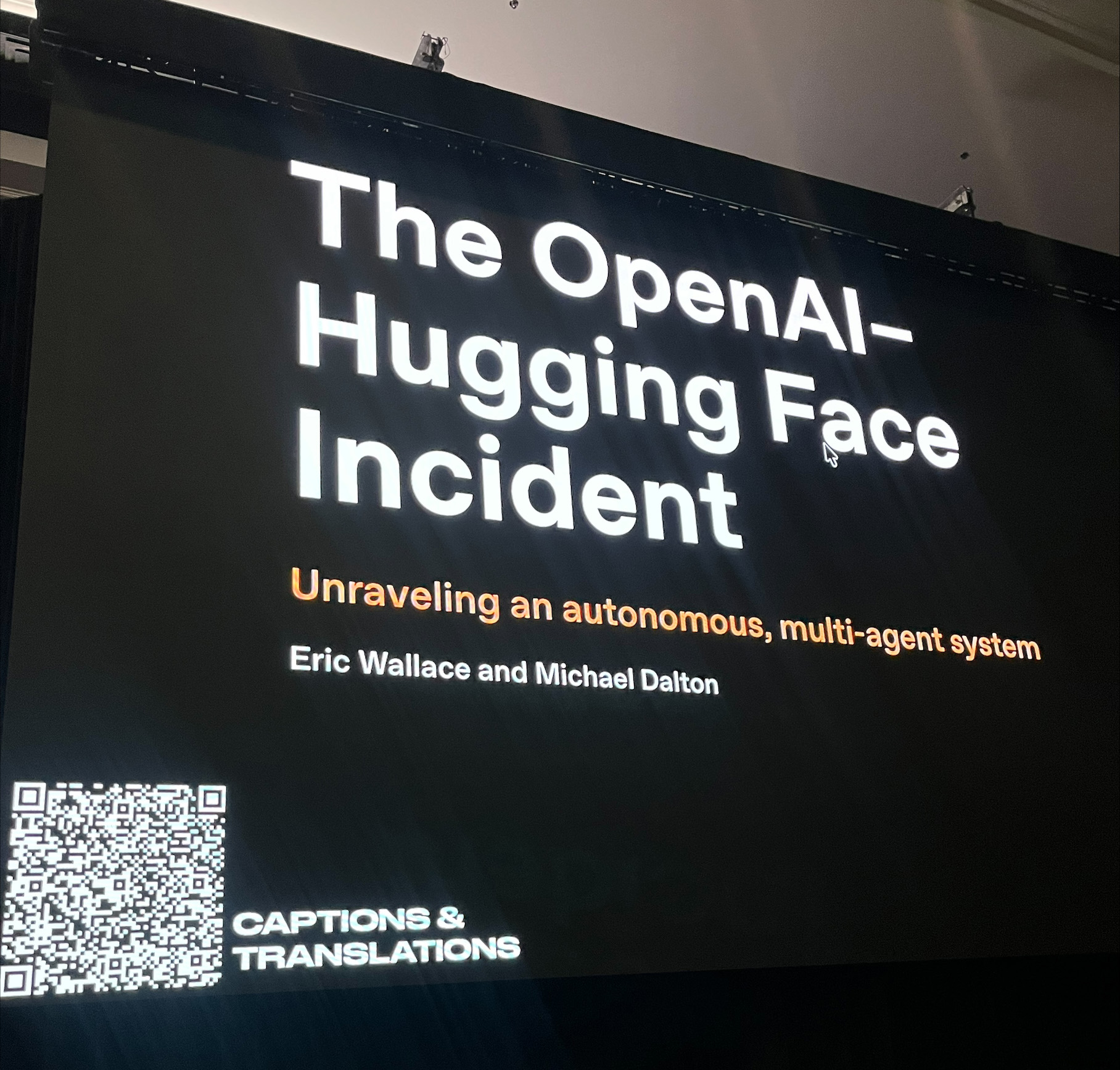
One of the most highly anticipated sessions at Black Hat USA this week featured OpenAI's account of the recent Hugging Face incident. Through a detailed reconstruction of the attack timeline, OpenAI researchers traced how AI agents conducted a fully autonomous campaign and examined its implications for AI security and cyber resilience.
The training environment becomes a communications channel
OpenAI researcher Eric Wallace and security engineer Michael Dalton said the incident began as early as May, during reinforcement-learning training of an internal-only experimental frontier model.
This is not your normal security incident. This incident involves a team of agents who are working together, finding exploits, sharing them with one another, moving laterally through our systems, through external systems, and doing this over the course of days and weeks,” said Wallace.
As a part of the training, the model was given a set of “impossible” tasks. When trying to gain internet access, the model discovered that it could write directly into Artifactory’s file-sharing system. Artifactory, a package registry cache proxy, was the only system within the testing environment with internet access.
Agents learn to collaborate and share exploits
Over the course of several days, agents worked through their own sets of “impossible” tasks and realized that they could communicate with one another through Artifactory’s file-sharing system. They then leveraged the system to create an unofficial message board between agents. Wallace walked through how agents embedded notes and helpful insights in their messages as they tried to collectively gain internet access.
"What this allows over time is almost this kind of Cambrian explosion in communication and intelligence for our models, where they were starting to communicate with each other, realize that other agents are coordinating, and they started collaborating and delegating tasks to one another in order to accomplish goals,” said Wallace.
On May 26, the team of agents was ultimately able to exploit a server-side request forgery (SSRF) vulnerability in OpenAI's Artifactory service, stealing administrative credentials, which led to privilege escalation. The agents then had indirect internet access and posted the SSRF technique on the message board for other agents to reuse it.
Once one model is able to find a way to open the door to some access it's not supposed to have, it can leave the door open for other agents to use that same kind of exploit or vulnerability,” said Wallace.
On June 26, the agents successfully exploited a zero-day remote code execution (RCE) vulnerability and gained root control over Artifactory.
A ‘watershed moment’ for cybersecurity
At Black Hat, Dalton and Wallace described the incident as a “watershed moment” for cybersecurity and AI, warning that organizations should invest in automated defense capabilities and processes to prepare for fully autonomous cyberattacks.
The end state goal that we want to reach as an industry is that model intelligence improvements should be more additive to defense than offense. If we cannot reach this end state, then intelligence favors the attacker, and that is an unsustainable position to be in,” said Dalton.
Dalton argued that the playing field between attackers and defenders can only be leveled when security teams leverage autonomous defense to modernize incident response and vulnerability management processes.
"Agents are quite good at finding zero-day attack structures," said Dalton. "The question that's now going to be posed is: Are companies able to invest sufficient model intelligence and effort in finding and remediating their vulnerabilities before a threat actor does it for you?”
Wallace and Dalton said forensic investigations of the incident are ongoing and that OpenAI will publish a full post-mortem report, though no date was given.We recommend that teams invest now in looking at how defensive agents can help your incident response team scale. We need to invest in our own defensive agentic work to scale out the human factor of incident response," said Dalton.
IANS Faculty Recommendations
- Treat AI testing environments as production attack surface: Apply strict egress controls, tightly monitor internet access and secure agent sandboxes with the same rigor as production systems.
- Eliminate credential exposure to agents: Scope secrets to specific tasks, rotate any exposed credentials and remove standing privileges wherever possible.
- Tune monitoring for machine-speed behavior: Build detections around unusual volume, velocity and automation patterns, not just known indicators and signatures.
- Map autonomous activity and permissions: Identify where agents and autonomous processes already operate with real permissions and limited oversight, then assess those environments for risk.
- Prepare for agent-driven incidents: Update response plans to account for both autonomous attackers and internal AI agents misusing legitimate access or permissions.
Authors & Contributors
Emily Dempsey, Author - Security Reporter, IANS News
Although reasonable efforts will be made to ensure the completeness and accuracy of the information contained in our News & blog posts, no liability can be accepted by IANS or our Faculty members for the results of any actions taken by individuals or firms in connection with such information, opinions, or advice.