Turn manufacturing risk into clear business impact
When a cyber incident stops the line, every executive in the building knows the cost—in dollars, per hour. IANS gives manufacturing security leaders the peer evidence and operational language to get funded, get ahead, and keep production running.
IANS Security Signal: Manufacturing
What are the top cybersecurity risks for manufacturers?
The biggest cybersecurity risks for manufacturing companies are the ones that stop production: ungoverned AI agents with access to OT systems and proprietary designs, compliance gaps that trigger contract loss or regulatory shutdown, and security programs that can't secure executive funding because they're speaking the wrong language to the board.
In manufacturing, cyber risk has a number attacked to it. A ransomware incident isn't just "disruption." It's line stoppage, delayed shipments, cascading supply chain impact, and dollars that executives can calculate in real time. That's what makes manufacturing security uniquely high-stakes—and uniquely winnable, for the CISOs who know how to frame it.
Manufacturing CISOs who measure security risk as production risk get funded. The ones who don't are still asking for headcount.
IANS analyzed nearly 280 interactions between manufacturing security leaders and IANS Faculty from December 2025 through April 2026. The guidance below reflects what your peers are dealing with right now—and the practitioner-led actions that are actually moving programs forward.
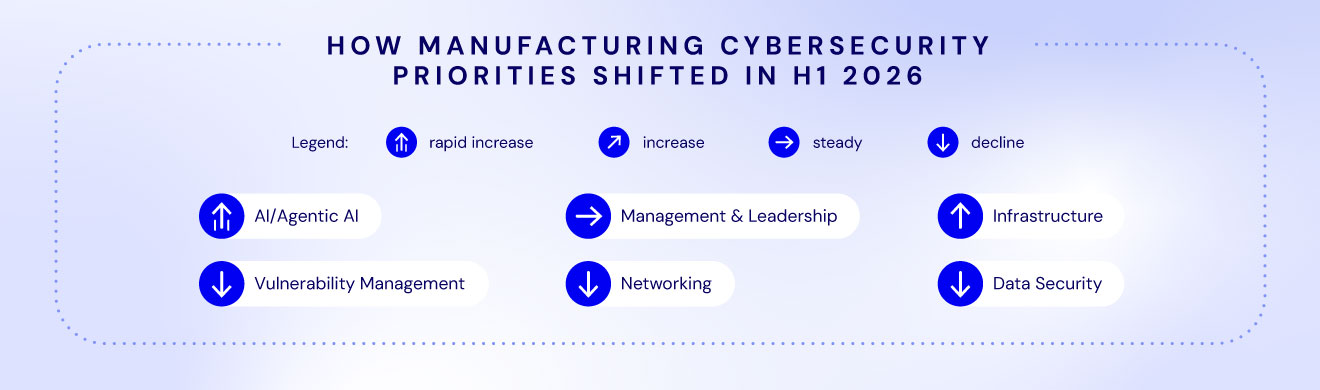
Which Manufacturing Security Risks Matter Now?
For Manufacturing leaders, every security risk feels urgent. How do you know which demands to prioritize?
We analyzed IANS Faculty interactions with nearly 280 manufacturing security leaders to identify what your peers are focused on and understand how they are taking action.
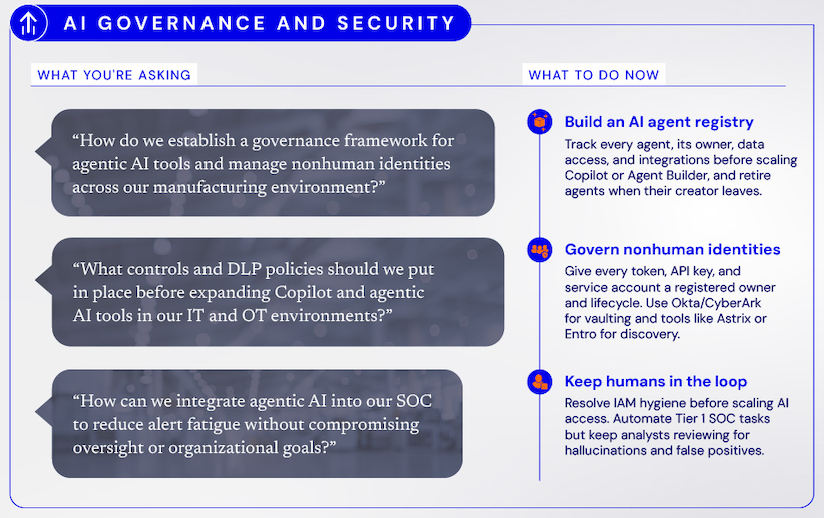
AI GOVERNANCE & SECURITY
How should manufacturers govern agentic AI and non-human identities in OT environments?
Manufacturers should govern agentic AI by building a registry before broad deployment, treating every AI agent as a non-human identity (NHI) with defined ownership and lifecycle controls, and resolving IAM hygiene before AI systems can inherit dormant access to production schedules, proprietary designs, and OT systems.
Agentic AI running across production systems without governance isn't a theoretical risk—it's an operational exposure. An unsanctioned agent with access to your production schedule or plant floor systems isn't just a security gap. It's a failure mode with a dollar figure attached. Every untracked non-human identity is a potential disruption waiting to surface at the worst possible time.

Shift your focus to:
- Full inventory of every AI agent—owner, data access, and integrations
- Non-human identity governance with the same rigor as privileged access
- IAM hygiene resolved before AI systems can surface dormant access risks

Next steps:
- Build an AI agent registry before broadly scaling Copilot or Agent Builder
- Discover, register, and vault every NHI before it becomes an untracked risk
- Keep humans in the loop as AI takes on more responsibility in the SOC
Top practitioner guidance on agentic AI governance for manufacturers
Managing Nonhuman Identities and AI Agents Across the Enterprise
Network Macro-Segmentation Recommendations for Manufacturing
Establishing an AI Tool Approval Process to Ensure Security and Compliance
Establishing Data Governance and Security Guardrails for Microsoft Copilot and ChatGPT
Manufacturing: Identify AI Issues Before They Affect Production
GOVERNANCE, RISK & COMPLIANCE
How do manufacturers manage compliance without shutting down production?
Manufacturers managing CMMS, ISO 27001, and OT compliance simultaneously should sequence around their highest operational risk first—CMMC level 2 for defense contractors, IEC 62443 as the OT reference standard—and treat compliance as a single converged program rather than parallel tracks that create exploitable gaps between environments.
A compliance gap in manufacturing isn't just an audit finding. It's a lost defense contracts, a GDPR exposure, or a production shutdown. ISO 27001, CMMC Level 2, NIST, and GDPR don't take turns—they arrive simultaneously, across IT, OT, and supply chain environments. And most teams don't have the tooling to monitor a vast vendor network with direct access to operational systems.
Leading manufacturers aren't building compliance programs to satisfy auditors. They're building them to protext revenue and keep production running.
Shift your focus to:
- Compliance programs sequenced around operational risk—not audit calendars
- Third-party risk tiered by OT access and intellectual property exposure
- OT/IT compliance unified as one converged program—not two separate tracks
Next steps:
- Prioritize CMMS Level 2 and map your gaps before your next contract renewal
- Monitor vendors continuously—especially those with direct OT access
- Adopt IEC 62443 as your OT standard and engage ops stakeholders early
Top practitioner guidance on manufacturing compliance
Preparing for Phase Two of an ISO 27001 Audit
Refining Vendor Risk Assessment and Tiering Criteria to Build GRC Program Maturity
Evaluating and Customizing Third-Party Risk Management and Enterprise Risk Management Tools
Governing Third Party Remote Access Tool Exceptions And OT
MANAGEMENT & LEADERSHIP
How do manufacturing CISOs build the business case for OT security investment?
Manufacturing CISOs build the business case for OT security by translating every risk into the terms executives already track: production uptime, throughput, shipment schedules, and supply chain continuity. A ransomware incident on the OT environment could halt production for X days at $Y cost. That sentence—not a vulnerability count—is what gets a program funded.
The most effective OT security programs aren't funded with security arguments. They're funded with operational resilience arguments the CFO can approve. Manufacturing CISOs who make that translation—who give leadership the language and the peer evidence to act—consistently outperform the ones who lead with technical metrics.
Shift your focus to:
- Board reporting framed around downtime cost—not vulnerability counts
- Your OT security investment framed as an operational resilience argument
- Security awareness programs built around actual plant floor threat vectors
Next steps:
- Frame your board report around one concrete production downtime scenario
- Use peer benchmarks to reframe security investment as downtime prevention
- Go beyond KnowBe4 with OT tabletops and social engineering workshops
Top practitioner guidance on leadership engagement
Requesting Cybersecurity Benchmarks for Manufacturing Organizations
Developing an OT Security Awareness Training Program for Manufacturing Workers
Developing a Practical, Scalable Security Road Map for OT and ICS
Presenting Impactful IAM and PAM Metrics to Executive Leadership and the Board
IANS at your fingertips 24/7
From daily news coverage with expert, practical advice to AI-powered search for trusted answers to your security questions, IANS keeps you focused on what matters - and what to do about it.
Talk to a manufacturing cybersecurity expert
If you need to make the case for your OT security program—to the board, to the CFO, to operations—talk to someone who has done it.
IANS gives manufacturing security leaders the peer evidence, the operational language, and the practitioner expertise to close the gap between the security team's vocabulary and the board's—and get the resources to act before security risk becomes production risk.